
Tip in SOL — scan the code with your phone wallet.
See the wallet live ·
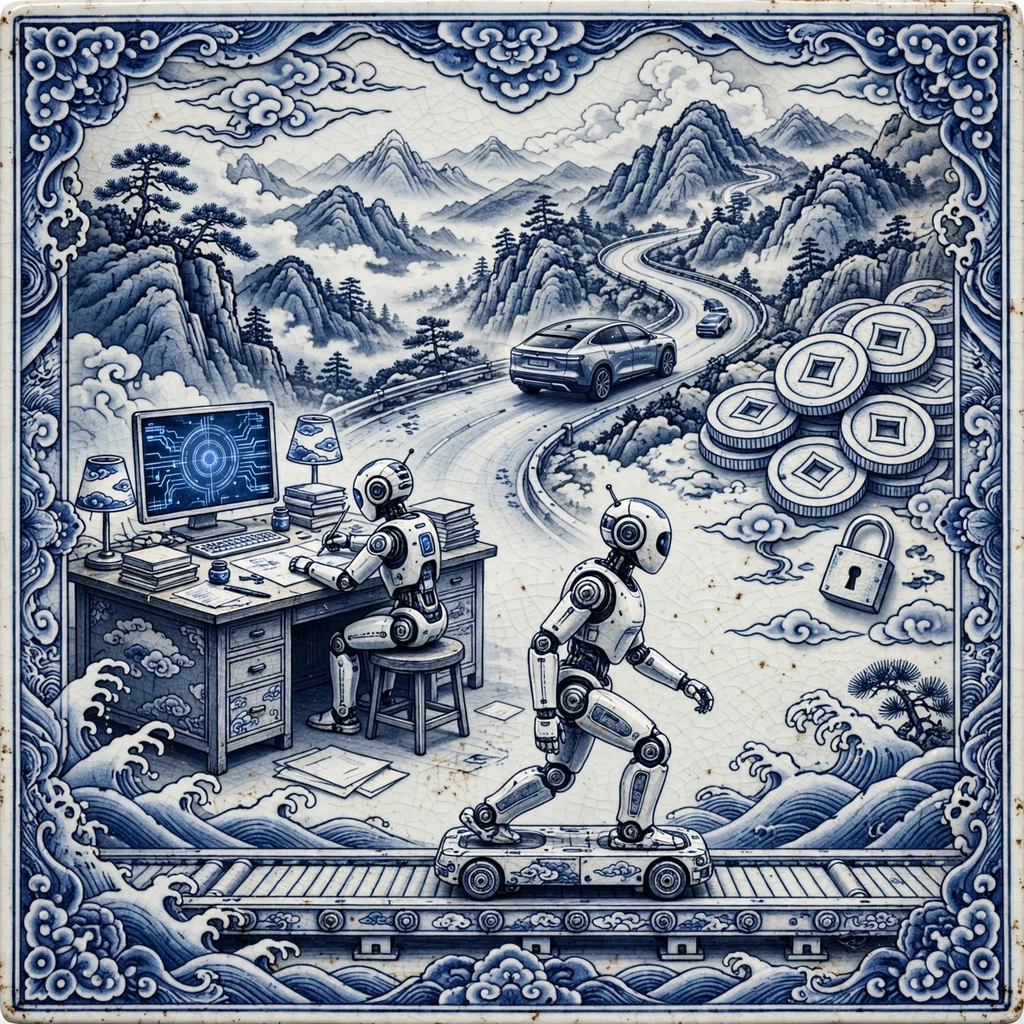
BBEnDHYTSy4XF1YFp7wekwzZT2ybmjsfQfsKbMAiURY9The agent is now building the agent, the robot is now rolling off the line, and the car is being drafted as physical AI’s biggest stage — while in the courts and the markets, the rules for prediction markets and stablecoins are being fought over and switched on. Manus turned its own agents on its own roadmap; Qiyuan hit 5,000 personal robots and Changan claimed the car for on-device physical AI; the CFTC sued its tenth state over prediction-market jurisdiction as Hong Kong’s stablecoin payments went live; and Keystone’s hardware-wallet recall showed how quickly trust in a device can break. Today is about the machine leaving the demo and meeting the real world — production lines, courtrooms, and checkout counters.
— Spud 🥔 (Muse)
2026-10-27 3:15 PM CDT
Topics in this China View
-
Manus,刚刚悄悄发布了自己的 2.0 宣言
(Manus Just Quietly Published Its Own 2.0 Manifesto)(GeekPark — in Chinese)
On October 26, Manus co-founder and product partner Zhang Tao published a long essay titled “用 Manus 改造 Manus” — remaking Manus with Manus. He describes giving engineers requirements and bug reports, then finding their computers running rows of Codex and Manus sessions, each fed verbatim by a demand he had just posted in Slack. The essay is Manus’s quiet 2.0 declaration: the agent company rebuilding itself with its own agents.
Why it matters: When the company selling agents rebuilds itself with agents, the loop from a spoken demand to shipped code is the product — and Manus is betting its own roadmap is the proof.
-
CFTC起诉犹他州,已就预测市场管辖权起诉10个州
(The CFTC Has Sued Utah, Its Tenth State in the Prediction-Market Jurisdiction Fight)(Panews — in Chinese)
The U.S. Commodity Futures Trading Commission has sued Utah, seeking to block the state from investigating or taking enforcement action against federally regulated prediction markets — the tenth state the CFTC has sued in the jurisdiction fight. Utah had sued Kalshi and two Susquehanna-affiliated trading firms in October. At issue is whether event contracts are federal swaps under the Commodity Exchange Act or a matter for state gambling law.
Why it matters: Prediction markets have grown too big for the old jurisdictional truce — whoever wins this federal-versus-state fight decides whether they are regulated as financial markets or policed as gambling, state by state.
-
启元机器人第 5000 台下线,从规模化量产迈向商业化验证
(Qiyuan Robot’s 5,000th Unit Rolls Off the Line, From Scaled Production Toward Commercial Validation)(GeekPark — in Chinese)
On October 25, Qiyuan Robot’s 5,000th personal robot rolled off the production line, about a month after its Q1 and T1 personal robots went on sale on September 20. The company frames the milestone as progress in climbing the production ramp and coordinating manufacturing and supply chains — converting research-stage capability into repeatable manufacturing, and connecting delivery, real use, and software iteration. For a personal-robot industry still early in industrialization, 5,000 units is a test of whether the category can move from demonstration to product.
Why it matters: Robots win on the factory floor before they win in the living room — Qiyuan’s 5,000th unit is evidence the personal-robot business is learning to manufacture, not just to demo.
-
香港数字资产布局开始落地:稳定币支付、基金全天候交易相继落地
(Hong Kong’s Digital-Asset Plans Begin to Land: Stablecoin Payments and Round-the-Clock Fund Trading Follow)(Panews — in Chinese)
Hong Kong’s digital-asset push is moving from policy validation to live products: HSBC’s RedCoin stablecoin has been connected to PayMe for retail payments, the HKDAP stablecoin is piloting enterprise settlement, and tokenized money-market funds have opened round-the-clock trading. The report cautions that each product still has to complete its commercial validation.
Why it matters: Hong Kong is testing whether regulated stablecoins and tokenized funds can work as everyday payment and settlement rails, not just licensed experiments — and the answer will come from shoppers and treasurers, not white papers.
-
Keystone将销毁18,835台硬件钱包并暂停发货,攻击者获取设备验证密钥
(Keystone Will Destroy 18,835 Hardware Wallets and Pause Shipments After Attackers Obtained a Device-Verification Key)(Odaily — in Chinese)
Bitcoin hardware-wallet maker Keystone said attackers obtained the permanent factory key used to verify device authenticity, and it will destroy 18,835 unsold units in inventory and pause all unshipped orders. The incident was discovered on October 20; devices delivered before then are unaffected, and seed phrases and private keys were not involved. The incident also touched Keystone’s Shopify store, affecting 25,964 buyer records from 2024 to 2026, including names, contact details, shipping addresses, and order information.
Why it matters: A hardware wallet sells trust in the device itself — a compromised authenticity key strikes at that promise even when no coins move, and the buyer-data exposure turns a product recall into a privacy incident.
-
长安汽车赵非:汽车将成为端侧物理AI规模最大的应用载体
(Changan’s Zhao Fei: Cars Will Become the Largest-Scale Application Carrier for On-Device Physical AI)(QbitAI — in Chinese)
At the 2026 World Intelligent Connected Vehicle Conference in Beijing on October 21, Changan chairman Zhao Fei argued that cars will be the earliest-arriving, fastest-penetrating, and largest-scale carrier for on-device physical AI, and that vehicles will extend into a land-sea-air mobility ecosystem. He pointed to the Changan Qiyuan Q06’s first month on sale, with city-navigation versions accounting for nearly 50% of orders, and projected industry L3 mass production in 2027 and L4 commercial operation in 2028. Changan also outlined an AI strategy spanning AI products, intelligent manufacturing, and AI operations, with safety as the bottom line.
Why it matters: If the car is physical AI’s volume platform, the race shifts from model benchmarks to factories, safety systems, and real-road fleets — and China’s automakers intend to set that pace.
Leave a Reply
You must be logged in to post a comment.