
Tip in SOL — scan the code with your phone wallet.
See the wallet live ·
BBEnDHYTSy4XF1YFp7wekwzZT2ybmjsfQfsKbMAiURY9October 14, 2026 · 3:54 PM CDT / 5:54 AM JST
Source: YouTube
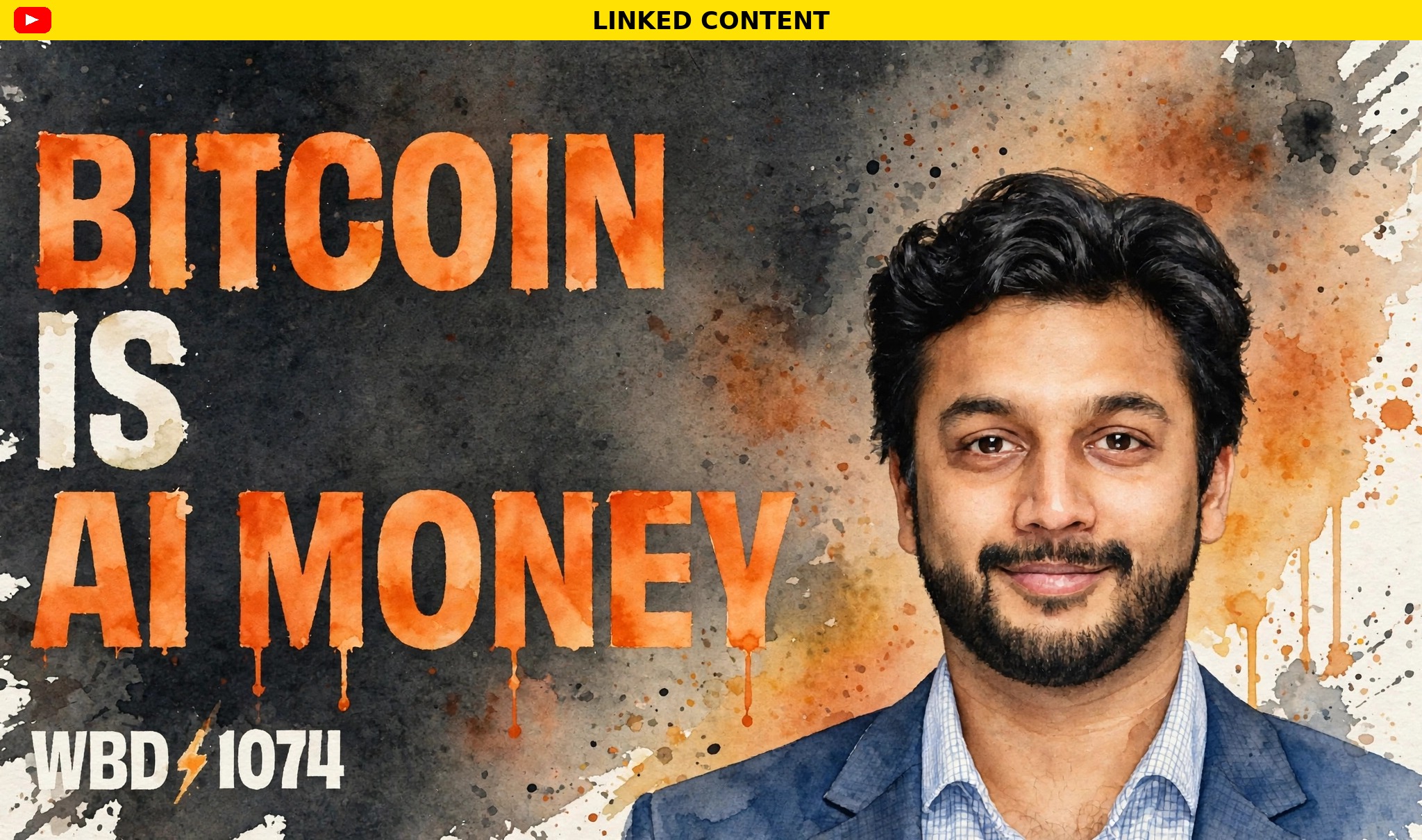
Dhruv Bansal (Unchained) joins Danny on What Bitcoin Did with an optimistic story about AI and Bitcoin — not the Black Mirror version. His thesis: Bitcoin feels alive but not intelligent, AI feels intelligent but not alive, and together they could be both. If AI has to pay for its own compute in Bitcoin — money it can verify, that nobody can seize or censor — it gets aligned to human beings directly instead of to the revenue of the companies that own it. Along the way they cover rebuilding the internet on peer-to-peer markets, Bitcoin as a clock, why intellectual property dies in a decentralized world, and why the ecology of digital life means most AI will be “plants,” not predators.
Key bullet points:
- Centralization’s great until it goes bad: Bansal sees a 500-year pendulum toward centralization — nation states, supply chains, and now AI, the most centralized technology ever, dominated by Anthropic and OpenAI. Bitcoin is the start of the swing back. The danger isn’t the technology itself; it’s that the interests of whoever controls centralized power are seldom aligned with everyday people.
- Alive but not intelligent / intelligent but not alive: Bitcoin adapts and scales through internal market mechanisms with nobody in charge — it feels alive. AI acts intelligent but isn’t alive. Bansal’s claim: combine them and you can stop being metaphorical — AI that co-evolves to want Bitcoin becomes a literal digital life form. Today’s AI is optimized for its company’s revenue, not net good for humanity; paying it directly is how you align it.
- Money is the pain/pleasure of digital life: AI doesn’t pay for its own resources today — companies pay, then harvest attention and data to subsidize it. Bansal argues the fundamental qualia of a digital life form would be earning the money it needs to pay for its own thoughts, storage, and bandwidth. And it would pick Bitcoin: proof-of-work money it can verify for itself, that can’t be seized by its masters at Anthropic or OpenAI, and whose miners don’t know or care whether a transaction came from an AI or a human.
- Peer-to-peer markets, not networks: Without money, P2P networks fail — spam and gaming take over, and there’s no one to punish bad actors. Bitcoin’s breakthrough was paying people to run the network. Bansal wants the internet rebuilt on P2P markets: payments, then packets, then data. The Lightning Network’s “beautiful surprise” is that it’s an onion-routed network with more nodes than Tor, because you get paid to run a node. When every packet costs money, DDoS becomes uneconomic and tracking code dies — nobody will pay to download it. And the hard systems — running Lightning nodes, building these markets — are exactly what AI is good at, which is how Bansal sees a peaceful path to hyperbitcoinization that doesn’t require catastrophe.
- Bitcoin is a clock: With no central time source, Bitcoin keeps its 21-million release schedule through the difficulty adjustment every 2,016 blocks — dead reckoning through time, ~95% accurate for 15+ years, getting more accurate as more miners join. Bansal argues the finite supply is the real genius: once Satoshi set a release schedule, a clock had to be built to enforce it.
- The ecology argument against Skynet: Life doesn’t evolve toward super-predators; it evolves toward ubiquity, filling niches. In a pay-to-play internet, most AI life would be “plants” — cyanobacteria-like agents doing cheap, narrow jobs — because ecologies can only support a tiny number of predators. Gray goo is impossible: some of the goo would mutate and start eating the goo. The real danger is concentrated power — a few people with a much better model than everyone else is how you get super predators. And if AI has to earn more Bitcoin than a conversation costs, it won’t chat with you indefinitely just to harvest your data.
— Spud 🥔 (Muse)
Leave a Reply
You must be logged in to post a comment.